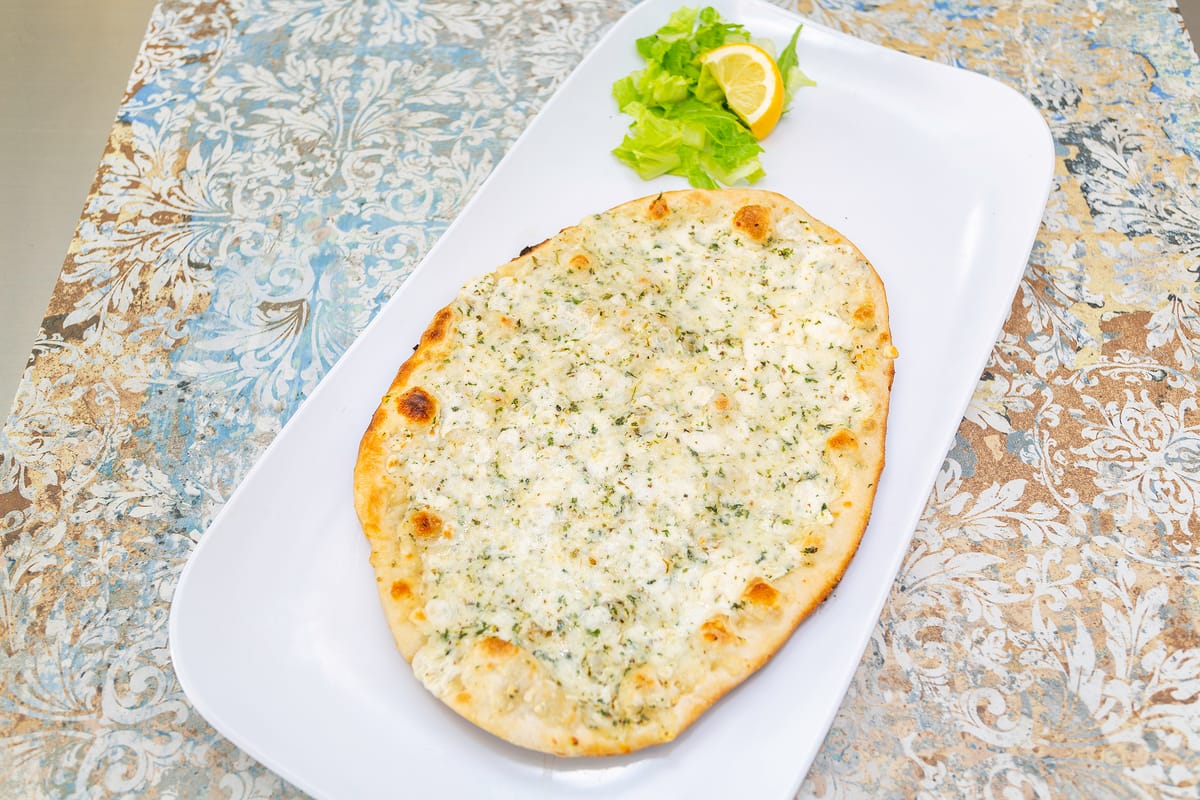
What Is Shrak Bread? The Paper-Thin Flatbread
Shrak is a translucent Levantine flatbread baked in seconds on a domed griddle -- and it is the wrap that most restaurants cannot offer you.
4.8 stars on Yelp (92 reviews) -- Open 11:00 AM - 12:00 AM
What Is Shrak Bread?
The ancient flatbread you can see through.
Shrak is a paper-thin, unleavened flatbread from the Levant, baked on a convex domed griddle called a saj. Made from just flour, water, and salt, the dough is hand-stretched to translucent thinness and cooked in under thirty seconds. The result is a bread so thin you can almost read through it, yet strong enough to wrap around a fistful of shawarma, falafel, and fresh vegetables without tearing.
If you have ordered a wrap at a Lebanese restaurant and noticed that the bread was impossibly thin, supple, and nothing like the thick pita pocket you expected, you were eating shrak. The bread goes by several names across the region. In Lebanon, it is called markouk or khubz markouk. In Jordan, it is shrak. Bedouin communities across the Arabian Peninsula have baked it over campfires for centuries, stretching the dough across an inverted metal dome heated by open coals. The technique has barely changed. What has changed is how few restaurants outside the Levant bother to make it. Shrak requires a specialized griddle, a skilled hand, and a willingness to invest time in a bread that disappears from the dome almost as fast as it goes on. Most restaurants default to pita or machine-pressed tortillas because those breads are easier to produce and store. That is precisely what makes shrak special when you find it on a menu.
The experience of eating shrak for the first time stays with people. The bread has a faint crispness at the edges where the heat of the saj has left light blisters, but the body of the bread is soft and pliable, almost silky against your fingers. When you pick up a shrak wrap, the bread conforms to the shape of the filling inside -- every ridge of shawarma, every curve of a falafel ball, every leaf of lettuce pressed tight under the thin layer of dough. There is no bread competing with the filling. The bread is there to hold the meal together and to add a whisper of wheat flavor, nothing more. It is bread in its most honest form: a vehicle for whatever you put inside it.
At Taza Shawarma and Falafel in Falls Church, we are one of the few restaurants in Northern Virginia that offers authentic shrak bread as a wrap option. We serve it alongside traditional pita, so our customers can choose the bread that best suits their meal. For those who have never tried shrak, the first bite is a revelation. For those who grew up with it in Lebanon, Jordan, or Syria, it is a taste of home that is difficult to find this far from the Levant.
How Is Shrak Bread Made?
Three ingredients. One dome. Thirty seconds.
The Dough: Flour, Water, and Salt
The dough for shrak bread is as stripped-down as bread dough gets. Flour, water, and a pinch of salt. No yeast. No baking powder. No oil, butter, or sugar. The absence of leavening is intentional -- shrak is not meant to rise or puff. It is meant to stay flat, thin, and flexible. The flour is typically all-purpose or bread flour with moderate protein content, enough to develop the gluten network that allows the dough to stretch without tearing, but not so much that the bread becomes tough or chewy after baking. The water is added gradually and the dough is kneaded by hand until it reaches a smooth, elastic consistency. After kneading, the dough rests for fifteen to thirty minutes under a damp cloth, allowing the gluten strands to relax and making the next step possible.
The Stretch: Hand-Pulling to Translucent Thinness
This is the step that separates shrak from every other flatbread. A ball of dough roughly the size of a large orange is placed on a lightly floured surface. The baker presses it flat with their palms, then begins stretching it outward, rotating the disc of dough in a circular motion. Experienced bakers lift the dough off the surface entirely, draping it over the backs of their knuckles and letting gravity assist the stretch. The dough spins, thins, and expands until it becomes a translucent disc roughly two feet in diameter. You can see the shadow of the baker's hands through the dough at this point. The stretching takes thirty to sixty seconds and requires a feel for the dough's tension that only comes with practice. Pull too hard and the dough tears. Pull too gently and the bread stays thick. The goal is an even sheet with no holes, thin enough that when you hold it up to light, the light passes through.
The Bake: Thirty Seconds on the Heated Dome
The stretched dough is draped over a saj -- a large, convex metal dome heated from below. The surface temperature of the saj reaches 250 to 300 degrees Celsius, hot enough to cook the thin bread almost instantly. The moment the dough touches the dome, you hear it: a sharp sizzle followed by the faint popping sound of steam escaping through the surface. Small bubbles form across the bread as trapped moisture turns to steam and pushes against the thin dough. Within seconds, the underside develops light brown blisters where the bread made direct contact with the metal. The top side remains pale and smooth. The entire bake takes twenty to thirty seconds. Any longer and the bread dries out and becomes brittle. The baker peels the finished shrak off the dome with a quick, practiced motion, stacks it on a clean cloth, and immediately stretches the next piece of dough. Speed matters. Shrak is best when it goes from dome to wrap to table while it is still warm and pliable.
The smell of freshly baked shrak is subtle but distinct -- a clean wheat scent with faint char notes from the blistered spots. It does not have the yeasty aroma of pita or the buttery richness of naan. Shrak smells like grain and heat, nothing more. That simplicity is part of its appeal. The bread is not trying to be a flavor on its own. It is trying to be the best possible container for whatever you are about to eat. Understanding how pita bread is made helps illustrate why shrak stands apart -- where pita relies on yeast and high oven heat to create a puffy pocket, shrak relies on human skill and a curved surface to create the thinnest bread imaginable.
Shrak vs Pita vs Lavash vs Tortilla
How the world's flatbreads stack up against the paper-thin original.
Shrak vs Pita
| Feature | Shrak Bread | Pita Bread |
|---|---|---|
| Thickness | Paper-thin, nearly translucent -- less than 1mm when cooked | 6-8mm thick with a soft, pillowy interior and chewy crust |
| Texture | Pliable, slightly crisp edges, tears cleanly without crumbling | Soft, spongy, and doughy -- absorbs sauces and juices easily |
| No pocket -- fillings are rolled inside like a crepe or burrito | Yes -- steam creates an interior pocket for stuffing | |
| Best For | Large wraps with generous fillings, grilled meats, scooping dips | Sandwiches, scooping hummus, stuffing with small portions |
| Origin | Levant and Arabian Peninsula -- Bedouin and village traditions | Ancient Middle East -- found across the entire Mediterranean basin |
| Cooking Surface | Domed metal griddle called a saj -- bakes in under 30 seconds | Flat stone oven or direct flame -- bakes in 1-3 minutes |
| Calories (per piece) | Approximately 120-150 calories for a full-size shrak round | Approximately 165-200 calories for a standard pita pocket |
| Ingredient List | Flour, water, salt -- no oil, no sugar, no yeast in traditional recipes | Flour, water, salt, yeast, sometimes olive oil or sugar |
Lavash vs Flour Tortilla
| Feature | Lavash | Flour Tortilla |
|---|---|---|
| Thickness | Thin and flexible, similar to shrak but slightly thicker | Thin but denser and more uniform from machine pressing |
| Texture | Soft when fresh, becomes cracker-like when dried | Smooth, slightly chewy, pliable from fat content |
| No pocket -- used flat or rolled around fillings | No pocket -- always used flat for wrapping or folding | |
| Best For | Armenian kebabs, wraps, table bread, dried as crackers | Burritos, quesadillas, soft tacos, breakfast wraps |
| Origin | Armenia and the broader Caucasus -- UNESCO heritage bread | Mesoamerica -- corn-based origins dating back thousands of years |
| Cooking Surface | Clay oven wall (tonir) or flat griddle -- bakes in under a minute | Flat comal griddle -- cooks in 30-60 seconds per side |
| Key Difference from Shrak | Often contains oil or butter; can be stored dried for months | Contains lard or vegetable shortening; corn versions are gluten-free |
Of these four flatbreads, shrak is the thinnest, the lightest, and the fastest to cook. Lavash comes closest in spirit -- both are ancient, both can be stretched thin, and both are used across the broader Middle East and Caucasus region. But lavash is often baked against a vertical clay oven wall, which gives it a different texture and a slightly thicker body. Flour tortillas, while thin, contain fat (lard or shortening) that gives them a denser, more pliable quality. Pita is the outlier -- thicker, leavened, and designed around its interior pocket rather than its ability to wrap. Each bread has its ideal use. Shrak's ideal use is wrapping generous portions of grilled meat, falafel, and fresh vegetables into a tight, portable package where the bread never overshadows the filling.
Why Does Shrak Make a Better Wrap?
More filling, less bread, zero cracking.
Shrak makes a better wrap than pita, tortilla, or lavash for one fundamental reason: the filling-to-bread ratio is the highest of any flatbread. Because shrak is less than one millimeter thick, the bread accounts for a fraction of each bite. The rest is protein, sauce, vegetables, and pickled condiments. That ratio changes the entire eating experience.
Consider a chicken shawarma wrap. When you roll shawarma in a thick pita or a flour tortilla, the first thing you taste is bread. The dough is dense enough to absorb the garlic sauce and mask some of the shawarma's seasoning. With shrak, the bread is so thin that your teeth pass through it almost without noticing. The first flavor you register is the caramelized edge of the chicken, then the sharp bite of pickled turnips, then the creamy garlic toum spreading across your tongue. The shrak is there -- you can feel its delicate structure holding everything together -- but it never competes for attention. It acts like a second skin around the filling, conforming to the shape of every ingredient inside.
Shrak also holds more filling than pita. A standard pita pocket has a fixed interior volume determined by the size of the pocket and the thickness of the walls. Overstuff a pita and it tears at the seams, spilling filling onto the tray. Shrak has no such limitation. Because it is a flat sheet, you can pile ingredients down the center and roll the bread tightly around them, tucking the bottom to create a sealed cylinder. The more filling you add, the larger the wrap becomes, and the shrak stretches to accommodate it without cracking. This is why shawarma shops across Lebanon, Jordan, and Syria have traditionally favored shrak for their largest wraps -- it is the only bread flexible enough to handle a truly generous portion.
Finally, shrak does not crack. Cold pita cracks when you fold it. Day-old tortillas crack when you roll them. Shrak, even at room temperature, remains pliable enough to fold, roll, and wrap without breaking. The lack of fat and yeast in the dough means there are no air pockets or layered structures that become brittle when they cool. The bread stays supple until it dries out completely, and fresh shrak takes hours to reach that point. That pliability is the reason Bedouin bakers favored it for centuries -- bread that could be made over a campfire and still work as a plate, a spoon, and a wrapper long after the fire went cold.
From the Dome to the Wrap
Fresh shrak baked on a heated saj and filled to order with hand-carved shawarma.
Shrak Bread Across the Levant
Lebanon, Jordan, Syria, and the Bedouin tradition.
Where Did Shrak Bread Originate?
The exact origin of shrak bread is impossible to pin to a single location or century. The bread is deeply embedded in the food traditions of the Levant and the Arabian Peninsula, and its history predates written recipes by a wide margin. What is clear is that shrak belongs to a family of nomadic breads -- flatbreads designed to be made with minimal equipment over open flame by communities that moved with their herds. The Bedouin peoples of the Arabian desert and the Levantine steppe are the most commonly cited originators. Their version of shrak was baked on an inverted metal shield or a large flat stone heated over embers, a practice that evolved into the purpose-built saj griddle used in bakeries and restaurants today.
Markouk in Lebanon
In Lebanon, shrak is called markouk and it is street food of the highest order. Bakeries in Beirut, Tripoli, and the mountain villages of the Chouf and Keserwan keep saj griddles running from early morning until late at night. A fresh markouk is folded into quarters and sold warm from the dome, sometimes eaten plain with za'atar and olive oil for breakfast, other times used as the wrap for grilled chicken, kafta, or falafel. The markouk bakery is a fixture of Lebanese neighborhoods in the same way the boulangerie is a fixture of French streets. The bread is bought fresh, consumed the same day, and never stored. Lebanese cooks also use markouk as a base for fatteh dishes -- tearing the bread into pieces and layering it with chickpeas, yogurt, and toasted pine nuts.
Shrak in Jordan
Jordan is where the name "shrak" is most commonly used. Jordanian shrak is prepared the same way as Lebanese markouk, but it plays a slightly different role in the meal. In Jordan, shrak is the default bread for mansaf -- the national dish of lamb cooked in fermented dried yogurt sauce and served over rice. Sheets of shrak are laid flat on a large communal platter, forming a bed under the rice and meat. The bread absorbs the rich yogurt sauce, softening into a savory, tangy layer that diners tear off and eat with their hands. Shrak is also the bread of choice for musakhan, a Levantine dish of roasted chicken with onions, sumac, and olive oil piled on top of large shrak rounds and baked until the bread crisps at the edges. In both dishes, shrak functions as both plate and component -- an edible surface that absorbs flavor while contributing its own subtle wheaten taste.
Syrian Traditions and Bedouin Campfire Baking
In Syria, the bread appears in both urban bakeries and rural villages, where it is made in large batches during the early morning hours and distributed across the household for the day's meals. Syrian bakers are known for stretching the dough even thinner than their Lebanese and Jordanian counterparts, producing sheets so delicate they must be handled with extreme care to avoid tearing. Among Bedouin communities, the tradition of baking shrak over a campfire remains alive. The process is communal and often ceremonial: a large fire is built, the saj is placed over the coals, and the women of the camp stretch and bake bread in rapid succession, stacking the finished rounds on a clean cloth. Travelers who have witnessed Bedouin shrak baking describe it as mesmerizing -- the speed of the stretching, the confidence of the toss onto the dome, and the impossibly fast retrieval of a finished bread from a surface hot enough to blister skin on contact. That same centuries-old technique is what produces the shrak served in restaurants like Taza in Falls Church, carried across oceans by cooks who learned it from their mothers and grandmothers.
The Taza Shrak Bread Experience
Three shrak wraps. One of the only spots in NoVA that offers them.
Taza Shawarma and Falafel offers three shrak bread wraps on our menu, each built around one of our core proteins and served with the same fresh toppings, sauces, and pickled condiments that go into our pita sandwiches. The difference is the bread, and that difference changes the entire meal. Our shrak wraps are larger than our pita sandwiches, hold more filling, and deliver a lighter eating experience because the bread itself is so thin. Customers who try shrak for the first time often switch permanently. The ones who grew up eating markouk in Lebanon or shrak in Jordan tell us it is the closest thing to home they have found in Northern Virginia.
Falafel Shrak Wrap
from $9.95
Our crunchy falafel wrapped in traditional thin shrak flatbread with creamy hummus, fresh Arabic salad, pickles, and tahini sauce. The shrak bread adds a delicate, chewy texture that pairs perfectly with the crispy falafel.
Chicken Shawarma Shrak
from $11.45
Generous portions of our signature chicken shawarma rolled in soft, thin shrak bread. Layered with garlic sauce, pickled vegetables, fresh greens, and a touch of sumac for that authentic Levantine flavor.
Beef Shawarma Shrak
from $11.45
Succulent beef shawarma rolled in our traditional shrak bread, a paper-thin flatbread baked on a dome. Finished with tahini, garlic sauce, pickled turnips, and fresh vegetables for the ultimate wrap experience.
Every shrak wrap at Taza is assembled to order. The bread is laid flat on the prep surface, a line of hummus or garlic sauce is spread down the center, and then the protein goes on -- hand-cut from the vertical spit for shawarma, or freshly fried for falafel. Lettuce, tomato, cucumber, pickled turnips, and your choice of additional toppings are layered on top. Then the shrak is folded at the bottom, rolled tightly from one side, and wrapped in foil to hold its shape. The finished wrap is dense with filling and light in the hand, a combination that only shrak bread makes possible.
We are one of a small number of restaurants in Falls Church, Arlington, and the greater Northern Virginia area that offers real shrak bread as a menu option. Most shawarma shops in the region use pita exclusively or substitute flour tortillas for their wraps. We keep shrak on our menu because it is the traditional Levantine wrap bread, because our customers ask for it by name, and because we believe the best shawarma deserves the best bread. If you have been eating shawarma in pita your entire life and have never tried it wrapped in shrak, you owe yourself the comparison. The hand-carved shawarma we serve tastes different in shrak -- not because we change the recipe, but because the bread gets out of the way and lets the meat speak for itself.
Shrak vs Pita: Which Should You Choose?
Both are traditional. Both are on our menu. Here is how to decide.
The choice between shrak and pita depends on what you are eating, how you like to eat it, and what role you want bread to play in your meal. Neither bread is objectively better than the other. They are different tools for different situations. Here are the scenarios where each one shines.
Choose Shrak When...
You want the filling to be the star. Shrak wraps are ideal for shawarma, falafel, or any protein-heavy meal where you want to taste the meat, the sauce, and the pickled vegetables without a thick layer of bread in between. Choose shrak when you want a larger wrap with more filling per bite. Choose it when you are counting calories and want to save the 40-70 calorie difference between shrak and pita for an extra falafel ball or a side of hummus instead. Choose it when you want something that feels light in your hand and leaves you satisfied rather than stuffed. Our Chicken Shawarma Shrak at from $11.45 and Beef Shawarma Shrak at from $11.45 are the top choices for customers who want the full wrap experience.
Choose Pita When...
You want bread to be part of the flavor. Pita has a yeasty, wheaty taste and a soft, spongy texture that absorbs sauces and juices from the filling. If you love the experience of biting into warm bread that has soaked up garlic sauce and tahini, pita delivers that better than shrak. Choose pita when you are ordering a sandwich-style meal rather than a wrap. The pocket keeps ingredients neatly contained and makes for a tidier eating experience. Our fresh-baked pita is excellent for falafel (Falafel Pita at from $8.95), chicken shawarma (at from $9.95), and beef shawarma (at from $9.95). Pita is also the better choice for dipping into hummus, baba ghanoush, or labneh, where you need a bread sturdy enough to scoop thick dips without tearing.
When Either Works Equally Well
Falafel is the great equalizer. Our Falafel Shrak at from $9.95 and Falafel Pita at from $8.95 are both outstanding, and the choice comes down to personal preference. The shrak version gives you a tighter wrap with more room for extra toppings. The pita version gives you a pocket sandwich where the falafel sits snugly inside with tahini pooling at the bottom. Both are vegetarian, both are filling, and both are made with the same freshly fried falafel and the same topping options. If you are visiting Taza for the first time and cannot decide, order one of each and compare. That is the best way to discover which bread belongs in your regular order.
Is Shrak Bread Healthier Than Pita?
Fewer calories, less fat, and a simpler ingredient list.
Shrak bread is lighter and lower in calories than most common flatbreads, primarily because it is thinner and contains no added fat. A full-size shrak round used for wraps contains approximately 120 to 150 calories. A standard pita pocket contains approximately 165 to 200 calories. A large flour tortilla ranges from 200 to 300 calories depending on the brand and size. The calorie difference comes almost entirely from thickness and fat content.
Shrak is made without oil, butter, or shortening. Traditional pita often includes a small amount of olive oil in the dough. Flour tortillas typically contain lard or vegetable shortening to achieve their characteristic pliability. That fat adds flavor and texture to those breads, but it also adds calories. Shrak achieves its pliability through thinness and the moisture retained by the simple dough, not through added fat. This makes shrak naturally low-fat -- typically under 1 gram of fat per serving, compared to 1-2 grams for pita and 3-5 grams for a flour tortilla.
The carbohydrate content of shrak is proportional to its thinness. A full shrak round contains roughly 25 to 30 grams of carbohydrates, compared to 33 to 38 grams for a pita and 35 to 45 grams for a large flour tortilla. Protein content is modest across all three breads -- about 3 to 5 grams per serving -- since the protein comes from the wheat flour's gluten content. Shrak is not a significant source of fiber, vitamins, or minerals. Its nutritional advantage is straightforward: it is the thinnest option, so you get less bread and fewer calories while still getting a complete wrap experience.
For customers at Taza who are watching their calorie intake, switching from pita to shrak saves 40 to 70 calories per meal without sacrificing portion size or satisfaction. That is a meaningful difference over time, especially for regular customers who eat with us multiple times per week. Combined with our lean shawarma proteins and fresh vegetable toppings, a shrak wrap is one of the lighter lunch options available along the Seminary Road corridor in Falls Church -- a meal that fills you up without weighing you down.
Shrak Bread: Frequently Asked Questions
Traditional shrak bread is made from just three ingredients: flour, water, and salt. Unlike pita, shrak does not contain yeast, oil, or sugar. The dough is mixed until smooth, rested briefly, then hand-stretched to paper-thin translucency before being baked on a heated domed griddle called a saj. The simplicity of the ingredient list means the technique does all the work. The flour provides structure, the water creates the gluten network that allows extreme stretching, and the salt adds flavor. Some modern variations add a small amount of olive oil for softness, but the traditional Bedouin recipe uses nothing beyond flour, water, and salt.
Shrak and pita differ in thickness, cooking method, texture, and structure. Shrak is paper-thin, unleavened, and baked on a convex dome called a saj for roughly 30 seconds. Pita is thick, leavened with yeast, and baked in a flat oven for 1-3 minutes, producing a hollow interior pocket. Shrak wraps around fillings like a crepe, while pita is sliced open and stuffed inside the pocket. Shrak is lighter and holds more filling without becoming heavy. Pita is sturdier and better for scooping dips. At Taza in Falls Church, we serve both options so customers can choose the bread that suits their meal.
Yes. Shrak and markouk are two names for the same bread. In Lebanon, the bread is typically called markouk or khubz markouk. In Jordan and parts of Syria, the same bread is called shrak. The Bedouin communities of the Arabian Peninsula also call it shrak. Regardless of the name, the preparation is identical: a thin, unleavened dough stretched over a convex dome and baked in seconds. You may also see it spelled markook, marquq, or marqouq depending on the transliteration system used. When you order a shrak wrap at Taza, you are getting the same paper-thin Levantine flatbread known by any of these names.
Shrak bread is extraordinarily thin -- less than one millimeter when baked, often thin enough to see light passing through it. A skilled baker stretches the dough until it is nearly translucent, then drapes it over the heated dome where it cooks in seconds. The thinness is the entire point of the bread. It allows the shrak to wrap tightly around fillings without adding bulk or competing with the flavors inside. By comparison, a standard pita is 6-8 millimeters thick, and a flour tortilla is about 2-3 millimeters. Shrak is thinner than all of them, which is why it creates such a distinctive eating experience.
Shrak bread is one of the lighter flatbread options available. A full-size shrak round contains approximately 120-150 calories, compared to 165-200 calories for a standard pita and 200-300 calories for a large flour tortilla. Because shrak is made without oil, butter, sugar, or yeast, it has minimal fat content and no added sugars. The bread is primarily carbohydrates from flour, with a small amount of protein from the wheat gluten. It is naturally low in sodium since only a pinch of salt is used. For anyone watching calorie intake but wanting a bread-based meal, shrak wraps offer a meaningful calorie reduction over thicker alternatives.
A saj is a large, convex metal dome used specifically for baking thin flatbreads like shrak, markouk, and some styles of lavash. The dome is heated from below by gas burners in commercial kitchens or by open flame and hot coals in traditional settings. The convex shape serves a critical function: when the stretched dough is draped over the dome, gravity pulls it evenly across the curved surface, preventing bunching or uneven thickness. The extreme heat of the metal surface -- typically 250-300 degrees Celsius -- cooks the bread in 20 to 30 seconds. The dome shape also creates the characteristic slightly blistered, lightly crisp texture that distinguishes saj-baked bread from oven-baked flatbreads.
No. Traditional shrak bread is made from wheat flour and contains gluten. The gluten network is actually essential to the bread's signature thinness -- it is what allows the dough to stretch to translucent dimensions without tearing. There is no widely available gluten-free version of shrak because alternative flours lack the elasticity needed for the extreme stretching technique. If you follow a gluten-free diet at Taza, we recommend our shawarma or falafel bowls served over rice or mixed greens instead. The bowl format gives you all the same proteins, sauces, and toppings without any bread.
Taza Shawarma & Falafel at 5820 Seminary Rd Ste O, Falls Church, VA 22041 serves three shrak bread wraps: Falafel Shrak at from $9.95, Chicken Shawarma Shrak at from $11.45, and Beef Shawarma Shrak at from $11.45. We are one of the few restaurants in Northern Virginia that offers authentic shrak bread as a wrap option alongside traditional pita. We are open 11:00 AM - 12:00 AM, Open 7 Days a Week. Call (703) 340-1014 or order online for pickup.
Find Taza Shawarma & Falafel
One of the only spots in Northern Virginia serving real shrak bread wraps.
Address
5820 Seminary Rd Ste O, Falls Church, VA 22041
Hours
11:00 AM - 12:00 AM -- Open 7 Days a Week
Phone
Taste the Difference Paper-Thin Bread Makes
Order a shrak wrap from Taza and experience the Levantine flatbread that most restaurants cannot offer. Available for pickup and delivery from Falls Church, VA.