What Is Rose Water? A Guide to Cooking with Rose Water
Rose water -- the fragrant distillation of Damask rose petals -- has perfumed desserts, drinks, and syrups across Persian, Levantine, Turkish, and South Asian kitchens for over a millennium. From Turkish delight to rice pudding, its floral warmth defines some of the world's most celebrated sweets.
4.8 stars on Yelp (92 reviews) -- Open 11:00 AM - 12:00 AM
The Floral Water That Shaped Centuries of Sweets
A few drops change everything -- from sugar syrup to something unforgettable.
Rose water is one of the oldest flavoring agents still in continuous use. Produced by steam distillation of the petals of Rosa damascena -- the Damask rose -- it is a clear, aromatic liquid that carries the essence of the rose in a form dilute enough for cooking, drinking, and topical application. The Damask rose is not the decorative garden variety sold at flower shops. It is a specific species cultivated for its intense fragrance and high concentration of aromatic compounds, grown commercially in Iran, Turkey, Bulgaria, India, and Morocco. The petals are harvested at dawn, when the volatile oils are at their peak, and processed within hours to preserve their aromatic integrity.
The distillation process that creates rose water is straightforward in principle: steam passes through a bed of fresh petals, capturing volatile aromatic compounds -- primarily citronellol, geraniol, nerol, and linalool. The vapor cools in a condensing coil and separates into two products: rose otto (or attar of roses), a concentrated essential oil valued in perfumery, and rose water, the hydrosol that carries the same aromatic compounds in a far more dilute, food-safe concentration. A single liter of rose otto requires three to five tons of petals, making it one of the most expensive essential oils in the world. Rose water, as the far more abundant byproduct, is the form that kitchens have used for centuries.
In Persian, rose water is called golab (گلاب) -- literally "rose water." In Arabic, it is ma ward (ماء ورد). These simple names describe an ingredient whose impact on global cuisine is anything but simple. Rose water is the defining flavor in Turkish delight, the aromatic backbone of Persian ice cream, the perfume in South Asian gulab jamun, and a traditional finishing touch on Levantine rice pudding and baklava. It appears in drinks from Iranian sharbat to Indian lassi to Levantine lemonade. No other single ingredient connects Persian, Arab, Turkish, and South Asian dessert traditions as completely as rose water does.
In this guide, you will learn what rose water is and how it is produced, trace its history across Persian, Levantine, Turkish, and South Asian cooking, explore its culinary uses from baklava to ice cream, compare it to orange blossom water in a detailed side-by-side analysis, review its health and beauty applications, and see how Taza Shawarma & Falafel draws on these traditions in Falls Church, VA.
From Persian Rose Gardens to Global Kitchens
A distillation technique that spread along trade routes for a thousand years.
The Damask Rose and Its Distillation
The Damask rose (Rosa damascena) takes its name from Damascus, though its cultivation likely predates the city's recorded history. The species is a natural hybrid, prized not for its visual beauty -- it is a modest, pale-pink flower -- but for its extraordinary concentration of aromatic compounds. A single Damask rose bloom contains over 300 identifiable volatile compounds, creating the complex fragrance that has made the rose a symbol of luxury and refinement across civilizations.
The technique of steam distillation to extract rose water was refined by Persian chemists in the early medieval period. The 10th-century Persian polymath Avicenna (Ibn Sina) is often credited with perfecting the copper alembic still that made efficient rose water production possible. His writings describe a distillation apparatus that separates the essential oil from the hydrosol -- the same basic process used in production facilities today. Persian rose water from the city of Kashan and the surrounding region became the gold standard, exported across the Islamic world and eventually to Europe through trade routes that connected Baghdad, Damascus, and Constantinople.
By the 12th century, rose water production had spread to every major region of the Islamic world. Turkish cultivation centered around Isparta province, which remains the heart of Turkish rose growing. Indian production took root in Rajasthan, where the Pushkar Valley became famous for its rose gardens. Bulgarian cultivation began later, in the 17th century, when Ottoman-era plantings in the Valley of Roses near Kazanlak created what is now one of the world's primary sources of rose otto. The Levant -- Syria, Lebanon, Jordan -- had its own production traditions, using locally grown Damask roses to produce the rose water that appears in regional desserts and drinks.
Regional Traditions of Use
Persian Tradition
Iran is the birthplace and spiritual home of rose water. Persian cuisine uses it in faloodeh (rose-scented frozen vermicelli dessert), bastani (saffron and rose ice cream), sharbat-e golab (rose syrup drink), and rice puddings. Rose water also plays a ceremonial role in Persian culture -- it is sprinkled at weddings, used to wash hands before formal meals, and offered in mosques. The city of Kashan hosts an annual rose water festival during the May harvest.
Levantine Tradition
In Lebanon, Syria, and Jordan, rose water shares the stage with orange blossom water. It appears in rice pudding (ruz bi haleeb), in some baklava syrup recipes, in muhallabia (milk pudding), and in traditional drinks. Levantine cooks tend to use rose water more sparingly than their Persian counterparts, often combining it with orange blossom water for layered complexity rather than using it as the sole floral agent.
South Asian Tradition
Indian and Pakistani cooking embraced rose water through centuries of Mughal culinary influence. It defines gulab jamun (the name itself means 'rose berry'), flavors kulfi, appears in biryani rice, scents kheer (rice pudding), and sweetens lassi. Rose water in South Asian use tends toward heavier concentrations than Levantine or even Persian usage, creating bold, unmistakable floral notes in desserts.
Turkish Tradition
Turkish delight (lokum) is perhaps the most globally recognized rose water confection. The chewy candy, invented in the Ottoman court, relies on rose water for its signature perfume. Turkish ice cream (dondurma), certain halva preparations, and rose-scented Turkish coffee also feature the ingredient. Isparta province remains Turkey's primary rose-growing region, producing both rose otto and culinary rose water.
Modern Global Spread
Rose water has entered Western pastry and cocktail culture in recent decades. Craft bartenders use it in gin-based cocktails and champagne drinks. Western patisseries incorporate it into macarons, panna cotta, and crème brûlée. The ingredient's move from ethnic specialty shops to mainstream grocery stores reflects a broader cultural interest in Middle Eastern and South Asian flavors that shows no sign of slowing.
A Fragrance That Shaped Civilizations
From Persian rose gardens to Levantine dessert tables -- rose water has traveled farther and lasted longer than almost any other flavoring agent in culinary history.
How Rose Water Is Used in Cooking
From syrup-soaked pastries to frozen desserts and aromatic drinks.
01
Baklava and Pastry Syrups
In many regional traditions, the sugar syrup poured over fresh baklava is scented with rose water. Turkish and some Levantine preparations favor rose water over orange blossom water, and the difference is immediately detectable: rose-scented baklava has a warmer, more perfumed character that pairs well with pistachio and walnut fillings. Half a teaspoon to one teaspoon per cup of syrup is the standard range. The rose note softens the sweetness and adds aromatic depth that plain sugar syrup cannot achieve on its own.
02
Rice Pudding and Milk Desserts
Rose water has been added to rice pudding across Persian, Levantine, and South Asian traditions for centuries. The floral note is introduced after the pudding is removed from heat to preserve the volatile compounds. Half a teaspoon per four servings is typical for a subtle presence, while Persian and Indian preparations may use a full teaspoon for a more assertive floral character. Muhallabia (Levantine milk pudding) and Indian kheer both rely on rose water as a core flavoring, often paired with cardamom and pistachios.
03
Turkish Delight (Lokum)
Rose-flavored Turkish delight is the confection most closely associated with rose water worldwide. The candy is made from starch and sugar cooked into a thick gel, then flavored with rose water and often tinted pink. The rose water is added during cooking, meaning the heat drives off some volatile compounds -- which is why Turkish delight uses a heavier hand with rose water than most other applications. The result is a chewy, fragrant candy with a clean floral taste that has been produced in Ottoman confectioneries since the 18th century.
04
Ice Cream and Frozen Desserts
Persian bastani (saffron and rose ice cream) is one of the great frozen desserts of the world. The combination of rose water, saffron, and pistachios creates a flavor profile found nowhere else in global cuisine. Rose water also appears in Indian kulfi, in Turkish dondurma, and in modern Western gelato and sorbet preparations. The key is adding the rose water to the base before churning, allowing the aromatic compounds to distribute evenly through the frozen mixture.
05
Drinks and Beverages
Rose water flavors an enormous variety of drinks across cultures. Persian sharbat-e golab mixes rose water with sugar, lime juice, and ice water for a pink, fragrant refreshment. South Asian rose milk (rooh afza) combines rose syrup with chilled milk. Rose lemonade adds a few drops to standard lemonade for a floral lift. Lassi, the Indian yogurt drink, often includes rose water alongside sugar and cardamom. In cocktail culture, rose water appears in gin-based drinks, champagne cocktails, and spritz variations.
06
Gulab Jamun and Syrup-Soaked Sweets
Gulab jamun -- fried milk-solid dumplings soaked in rose-scented sugar syrup -- is one of the most popular desserts across South Asia. The name itself derives from golab (rose water) and jamun (a plum-sized fruit). The syrup is heavily rose-scented because the dumplings absorb liquid during soaking, diluting the flavor. Similar syrup-soaked sweets across the Middle East and South Asia, including jalebi and rasgulla, sometimes incorporate rose water into their soaking syrups.
07
Cookies and Confections
Maamoul and ghraybeh -- Levantine shortbread cookies -- sometimes include rose water in the dough or dusting syrup. Persian rice cookies (nan berenji) are rose-scented. Indian barfi and peda often feature rose water alongside cardamom. The key in baked goods is accounting for heat loss: some aromatic compounds evaporate during baking, so recipes may call for slightly more rose water than a no-bake application. The baked result should carry a gentle rose note, not an overpowering one.
08
Savory and Crossover Uses
While rose water is overwhelmingly a sweet-side ingredient, it crosses into savory territory in certain traditions. Mughal-era biryanis sometimes include a few drops of rose water sprinkled over the rice before the final steaming (dum). Some Persian rice dishes use rose water in the soaking liquid. Moroccan ras el hanout spice blends may include dried rose petals, carrying a faint echo of the same aromatic profile. These savory uses are subtle -- the rose should be an almost imperceptible background note.
The Ingredient You Smell Before You Taste
Rose water works on the nose before it reaches the tongue -- its warmth, sweetness, and complexity arrive through aroma first, flavor second.
Rose Water Beyond the Kitchen
A thousand years of traditional medicine and cosmetic use.
Anti-Inflammatory Properties
The phenolic compounds in rose water, particularly citronellol and geraniol, have demonstrated anti-inflammatory activity in clinical studies. Research published in the Iranian Journal of Basic Medical Sciences found that rose water reduced inflammation markers when applied topically and when consumed. Traditional Persian and Ayurvedic medicine has used rose water for sore throats, digestive inflammation, and skin irritation for centuries. Modern research is beginning to explain the mechanisms behind these long-standing folk practices, though rose water should be understood as a gentle complement to, not a substitute for, medical treatment.
Skin Care and Cosmetics
Rose water has been used as a facial toner and skin-soothing agent since antiquity. Cleopatra is said to have bathed in rose water, though the historical record is unclear. What is clear is that rose water has been a consistent presence in beauty routines across Persian, Arab, and South Asian cultures for over a millennium. Its mild astringent properties tighten pores, its anti-inflammatory compounds reduce redness, and its natural fragrance eliminates the need for synthetic perfumes in skincare products. Modern beauty brands now incorporate rose water into serums, mists, and masks, marketing the same benefits that traditional practice identified long ago.
Mood and Relaxation
The aromatic compounds in rose water have been studied for their effects on mood and anxiety. A study in the Journal of Complementary and Integrative Medicine found that inhalation of rose water vapor reduced anxiety scores in participants undergoing medical procedures. Traditional uses align with this finding: Levantine and Persian households have long served rose water in warm drinks as a calming evening beverage. The practice of sprinkling rose water on pillows for better sleep persists in South Asian households. Whether the mechanism is pharmacological, placebo, or conditioned by cultural association, the practical effect -- a sense of calm and comfort -- is consistent across reports.
Zero-Calorie Flavoring Agent
From a nutritional standpoint, rose water's greatest practical benefit is what it does not contain. It has zero calories, zero sugar, zero fat, and zero sodium. As a flavoring agent, it creates a perception of sweetness and richness that allows cooks to reduce sugar in desserts without the final product tasting incomplete. The floral aroma primes the palate to expect sweetness, meaning a rose-scented dessert with 20 percent less sugar can taste as satisfying as a fully sweetened version. This makes rose water a practical tool for anyone trying to reduce sugar intake while maintaining flavor satisfaction.
A Note on Traditional Remedies
Rose water is not a medicine and should not replace medical treatment. Its traditional uses reflect centuries of practical observation across cultures that valued food-as-wellness approaches. The anti-inflammatory, calming, and cosmetic applications are gentle enough for daily use and carry essentially no risk at culinary dosages. Modern research is gradually catching up to what Persian grandmothers and Ayurvedic practitioners have practiced for generations: this water does more than smell pleasant.
Rose Water in Levantine and Mediterranean Desserts
The floral thread connecting sweets across the region.
Levantine Preparations
In Lebanese, Syrian, and Jordanian kitchens, rose water often works alongside orange blossom water rather than replacing it. Rice pudding may include both for layered complexity. Some baklava recipes use rose water exclusively in the syrup, while others blend the two floral waters. Muhallabia -- the Levantine milk pudding thickened with cornstarch -- is sometimes finished with rose water and garnished with crushed pistachios and a drizzle of rose syrup. The Levantine approach to rose water tends toward restraint: enough to register as a floral warmth, never enough to dominate the dairy or pastry it accompanies.
Persian and Turkish Preparations
Persian and Turkish dessert traditions use rose water more assertively than Levantine ones. Turkish delight is the most recognized example, but Persian faloodeh -- a semi-frozen dessert of thin vermicelli noodles in rose-scented syrup over crushed ice -- is equally dependent on the ingredient. Persian saffron ice cream (bastani) pairs rose water with saffron and pistachios for a flavor combination that exists nowhere else. These traditions treat rose water as a primary flavor, not a background accent, and the resulting desserts have bold, unmistakable floral character.
South Asian and Modern Western Use
South Asian desserts use rose water at concentrations that would overwhelm Levantine palates -- gulab jamun syrup is heavily rose-scented because the absorbent dumplings dilute the flavor during soaking. Barfi, peda, and ras malai all feature rose water prominently. In modern Western pastry, the ingredient appears in macarons, panna cotta, chocolate truffles, and crème brûlée -- often paired with ingredients like lychee, raspberry, or cardamom that complement the floral profile. These newer uses reflect a growing appreciation for Middle Eastern and South Asian flavor traditions in global cuisine.
Why Rose Water Persists in Modern Pastry
Synthetic rose flavoring exists and costs a fraction of genuine steam-distilled rose water. Yet the natural product has not been displaced. The reason is complexity: genuine rose water contains over 300 aromatic compounds in their natural ratios, creating a flavor and fragrance that synthetic recreations -- which typically isolate one or two dominant compounds -- cannot replicate. Artificial rose flavor tastes flat and chemical next to the real thing. Professional pastry chefs and home cooks who have worked with genuine rose water can detect the synthetic version immediately.
There is also a cultural dimension. Rose water connects a dessert to a culinary lineage that stretches back to medieval Persia. The grandmother who added golab to her rice pudding by instinct did not measure in teaspoons -- she measured by nose, by memory, by the way the kitchen smelled when her own mother cooked. That sensory inheritance cannot be bottled synthetically. It is transmitted through the real ingredient, used in the same way, connecting generations across time and geography.
Rose Water vs. Orange Blossom Water
Two floral hydrosols with distinctly different personalities.
| Characteristic | Rose Water | Orange Blossom Water |
|---|---|---|
| Botanical Source | Rosa damascena (Damask rose) -- petals harvested at peak bloom in late spring | Citrus aurantium (bitter orange tree) -- blossoms harvested in spring |
| Extraction Method | Steam distillation of fresh petals -- the hydrosol byproduct of rose otto essential oil production | Steam distillation of fresh blossoms -- the hydrosol byproduct of neroli oil production |
| Aroma Profile | Deeply floral, perfumed, and heady -- warm with honeyed richness and a lingering finish | Light, citrusy-floral with honeyed sweetness -- clean, bright, and less assertive |
| Flavor Intensity | Stronger and more forward -- can dominate if overused, requiring careful measurement | Subtle and delicate -- a background note that lifts without dominating the dish |
| Primary Culinary Use | Turkish delight, ice cream, rice pudding, lassi, gulab jamun, baklava, and heavy syrups | Baklava syrup, knafeh, rice pudding, lemonade, cookies, and light pastries |
| Regional Dominance | Persian, South Asian, Turkish, and Levantine cooking -- Iran, India, Turkey, Lebanon | Levantine, North African, and Southern French cooking -- Lebanon, Morocco, Tunisia |
| Substitutability | Orange blossom water provides a lighter alternative but the flavor profile differs significantly | A few drops of vanilla extract approximates the sweetness but not the floral character |
| Overdose Risk | High -- even a quarter teaspoon too many can make a dish taste like perfume or soap | Low -- even moderate amounts stay pleasant, though excess can taste soapy |
| Color in Liquid | Clear and colorless -- though dried rose petals are often added as a visual garnish | Clear and colorless -- does not alter the appearance of syrups or drinks |
| Shelf Life | 12 to 18 months sealed at room temperature -- refrigeration preserves aroma quality | 12 to 18 months sealed at room temperature -- similar storage requirements |
Can You Use Both Together?
Combining rose water and orange blossom water is a time-honored technique in Levantine and North African desserts, particularly rice pudding and milk-based custards. The combination creates a more nuanced floral profile than either ingredient achieves alone: the deep, warm perfume of rose balanced by the lighter, citrusy brightness of orange blossom. When using both, reduce the quantity of each by roughly a third to prevent the combined floral character from overwhelming the dish. The goal is a layered fragrance that unfolds gradually -- warmth from the rose arriving first, followed by the brightness of the orange blossom -- rather than a single dense wave of floral flavor.
How to Buy and Store Rose Water
Quality varies enormously. Here is what to look for.
What to Look For
The ingredient list on a quality bottle of rose water should contain exactly one item: rose water (or Rosa damascena hydrosol). Many commercial products dilute genuine rose water with plain water or, worse, use synthetic rose flavoring with water as the base. Read labels carefully: "rose water" and "rose-flavored water" are not the same product. Avoid bottles that list "natural flavors," "fragrance," or preservatives -- genuine steam-distilled rose water is naturally shelf-stable and needs no additives.
Middle Eastern and South Asian grocery stores are the best sources, as they carry the ingredient as a staple rather than a specialty item and turnover is high. Lebanese brands like Cortas and Al Wadi, Iranian brands from the Kashan region, and Indian brands like Dabur are widely available and reliable. Specialty food stores and online retailers offer a wider selection but at higher prices. Expect to pay four to ten dollars for a 300ml bottle of genuine distilled rose water.
The simplest quality test is the smell. Open the bottle and hold it a few inches from your nose. Genuine rose water smells like fresh roses -- warm, complex, and multi-layered. Synthetic or diluted products smell sharp, one-dimensional, or vaguely chemical. If the aroma does not make you think of actual roses, the product is not worth buying.
Storage Guidelines
Unopened Bottles
Store in a cool, dark place away from direct sunlight and heat sources. The volatile aromatic compounds degrade with UV exposure and temperature fluctuations. A pantry shelf or kitchen cabinet is ideal. Unopened, genuine distilled rose water keeps for 18 to 24 months.
After Opening
Seal the bottle tightly after each use to minimize oxidation and evaporation of volatile compounds. Refrigeration is not required but extends the aromatic life. If you use rose water infrequently, transfer the remaining liquid to a smaller glass container to reduce the air-to-liquid ratio.
Testing Freshness
Pour a small amount into your palm, rub your hands together, and inhale. Fresh rose water has a clear, warm, multilayered floral scent. If the aroma is faint, flat, or has developed an off note, the water has lost its potency and should be replaced. Rose water that smells like nothing is functionally expired.
Glass vs. Plastic
Always buy rose water in glass bottles. Plastic containers absorb and leach aromatic compounds over time, diminishing the fragrance and potentially introducing off-flavors from the plastic itself. Glass is inert, preserves the product as the distiller intended, and protects the volatile compounds from degradation.
Taste the Levantine Tradition
Fresh-made shawarma, falafel, and desserts at 5820 Seminary Rd Ste O -- open 11:00 AM - 12:00 AM
Rose Water Traditions at Taza
Levantine flavor, Falls Church VA -- 5820 Seminary Rd Ste O, Falls Church, VA 22041
The Levantine and Mediterranean flavor traditions that make rose water a pantry essential -- floral-scented syrups, perfumed desserts, aromatic drinks -- are the same traditions that inform everything at Taza Shawarma & Falafel. Our desserts and beverages draw from a culinary lineage that has used floral waters for centuries, bringing those flavors to Seminary Road in Falls Church.
Our rice pudding follows the traditional Levantine preparation: slow-cooked with whole milk, sweetened gently, and finished with the floral water that gives the dessert its characteristic warmth. At $2.95, it is one of the most affordable ways to experience an authentic Levantine dessert rooted in the same traditions that made rose water essential. Paired with a warm pita bread at $0.95, it becomes a simple, satisfying snack.
Our lemon mint drink at $5.95 captures the same refreshing character that defines traditional Levantine beverages. The combination of fresh lemon, mint, and a touch of sweetness creates the bright, aromatic experience that rose water lemonade delivers in cafes across the Levant. For something different, our Classic smoothie at $5.95 blends banana and strawberry into a cool, fruity alternative.
Rice Pudding
$2.95
Traditional Levantine rice pudding with floral water, cinnamon, and creamy whole milk
Lemon Mint
$5.95
Fresh-squeezed lemon with mint -- the bright, refreshing character of Levantine drink traditions
Classic
$5.95
Banana and strawberry blended smooth -- a refreshing complement to any meal
Hummus
$4.95
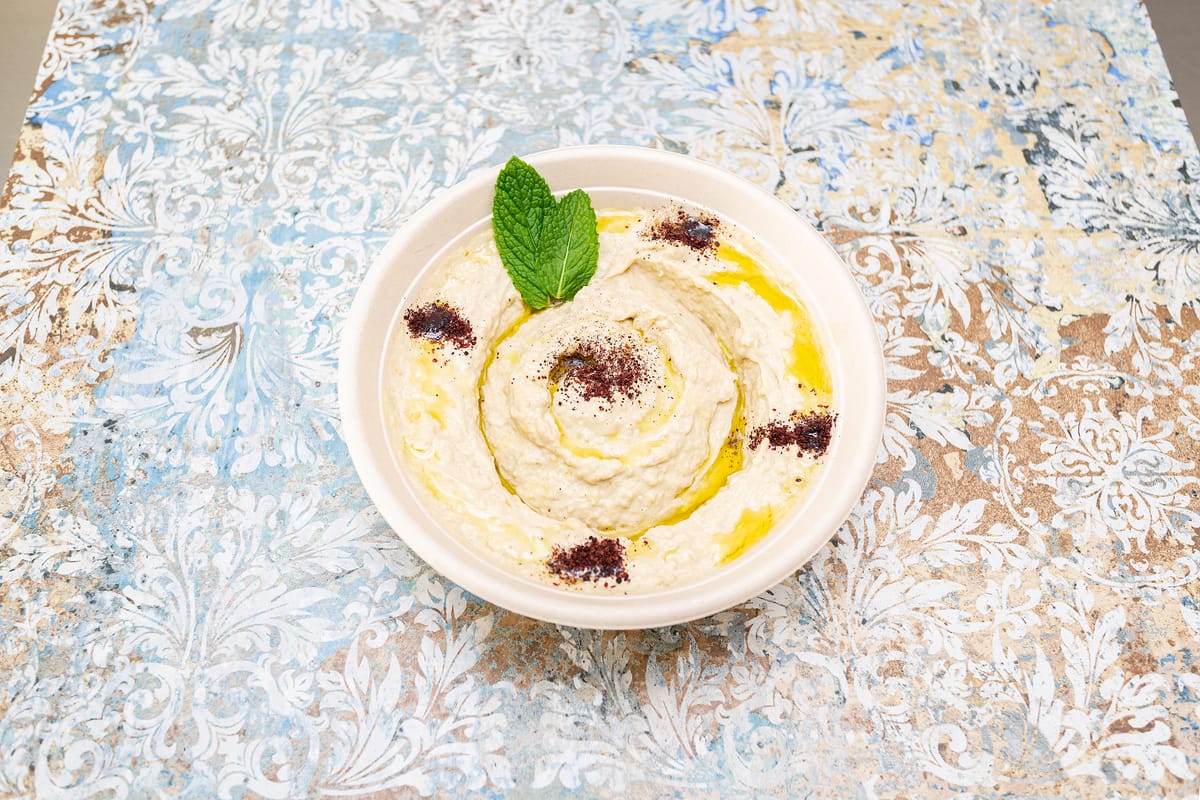
Creamy chickpea dip with tahini, lemon, and olive oil -- a Levantine pantry staple
Labneh
$4.95
Thick strained yogurt with olive oil and dried mint -- a traditional meze side
Baba Ghanouj
$4.95
Smoky roasted eggplant dip with tahini and garlic -- served with warm pita
The Levantine Pantry Starts Here
Rose water, orange blossom water, tahini, olive oil, sumac -- the building blocks of a cuisine that has fed the Mediterranean for millennia.
Rose Water: Frequently Asked Questions
Rose water is a clear, aromatic liquid produced by steam distillation of the petals of Rosa damascena, commonly known as the Damask rose. During distillation, steam passes through fresh rose petals, capturing their volatile aromatic compounds -- primarily citronellol, geraniol, and nerol. The condensed steam separates into two products: rose otto essential oil, which is highly concentrated and used in perfumery, and rose water, which is the hydrosol that remains. The water carries the fragrance of the rose in a dilute, food-safe form suitable for culinary, cosmetic, and traditional medicinal use. Rose water has been a foundational ingredient in Persian, Levantine, South Asian, and Turkish cooking for well over a thousand years.
Rose water is produced through steam distillation, a technique refined in Persia during the early medieval period. Fresh Damask rose petals are harvested at dawn, when the essential oil concentration is highest, and placed in a copper or stainless steel alembic still. Steam is passed through the bed of petals, releasing volatile aromatic compounds into the vapor. The steam rises through a condensing coil where it cools and liquefies. The resulting liquid separates into two layers: rose otto essential oil floating on top, and rose water below. The rose water is collected, filtered, and bottled. Traditional producers in Iran, Turkey, and India still use copper stills that have been in family workshops for generations, though modern stainless steel equipment has improved consistency. It takes approximately three to five tons of rose petals to produce one kilogram of rose otto, and the distillation process yields large volumes of rose water as a byproduct.
Rose water has a distinctive flavor that is intensely floral, slightly sweet, and unmistakably rose-forward. Unlike orange blossom water, which has a light citrusy quality that blends into backgrounds, rose water announces its presence. The flavor is warm and perfumed, with honeyed undertones and a lingering finish that coats the palate. In small quantities, it adds a sophisticated, aromatic dimension to desserts and drinks. In excess, it crosses from pleasant to soapy or perfumed -- a common mistake among first-time users. The key to working with rose water is restraint: a few drops transform a dish, while a few drops too many ruin it. Quality matters significantly, as lower-grade rose waters can taste harsh or chemical, while properly distilled Damask rose water has a smooth, rounded character.
Rose water and orange blossom water are both floral hydrosols produced by steam distillation, but they come from different plants and produce distinctly different results in cooking. Rose water is distilled from Rosa damascena petals and has a heavy, perfumed, assertive floral character. Orange blossom water comes from the blossoms of the bitter orange tree and has a lighter, citrusy-floral quality. In practical cooking terms, rose water is stronger and less forgiving -- it is easy to add too much and create a perfumed, soapy taste. Orange blossom water is more subtle and harder to overdo. Persian and South Asian cuisines favor rose water in sweets like Turkish delight, gulab jamun, and lassi. Levantine and North African cuisines tend toward orange blossom water in baklava syrup, knafeh, and lemonade. Some desserts, including rice pudding, use both for layered complexity.
Rose water appears across an enormous range of desserts and drinks in Persian, Levantine, South Asian, and Turkish cooking. It is the defining ingredient in Turkish delight (lokum), where it provides the floral perfume that makes the candy distinctive. It flavors gulab jamun -- fried milk dumplings soaked in rose-scented syrup -- across South Asia. Persian ice cream (bastani) relies on rose water and saffron for its characteristic flavor. Rice pudding in many traditions is finished with rose water and garnished with pistachios. Baklava in certain regional styles uses rose water instead of or alongside orange blossom water in the syrup. It flavors lassi, the South Asian yogurt drink, and Indian kulfi. In Levantine cooking, it appears in rice pudding, some versions of muhallabia (milk pudding), and in syrups for semolina cakes. Rose-flavored lemonade, rose milk, and rose syrup drinks are popular across Iran, India, and the broader Middle East.
Rose water has been used in traditional medicine across Persia, the Levant, and South Asia for centuries. The aromatic compounds in rose water, particularly citronellol and geraniol, have been studied for their anti-inflammatory and antioxidant properties. Research published in the Iranian Journal of Basic Medical Sciences found that rose water exhibited anti-inflammatory effects comparable to mild over-the-counter preparations. Traditional uses include rose water as a digestive aid after heavy meals, as a mild sedative for anxiety and insomnia, and as a topical treatment for skin irritation and redness. It contains zero calories, zero sugar, and zero fat, making it a calorie-free flavoring agent. Applied topically, it has been used as a facial toner for centuries and is found in many modern skincare products. While rose water is not a pharmaceutical substitute, its long history of practical use across multiple cultures and the emerging research on its aromatic compounds suggest genuine, if gentle, therapeutic value.
Rose water requires more careful measurement than most flavoring agents because the line between perfect and overwhelming is narrow. For a cup of simple syrup (equal parts sugar and water), half a teaspoon to one teaspoon is typically sufficient. For rice pudding serving four to six people, half a teaspoon stirred in after cooking provides a clear floral note without domination. For a pitcher of lemonade, one to two teaspoons creates a detectable rose character. For ice cream or milk-based desserts, one teaspoon per liter of base is a starting point. The universal rule is to start with less than you think you need and add gradually. Taste after each small addition. If you can clearly identify rose as the dominant flavor note rather than a background presence, you have likely added too much. The ideal use creates an aromatic lift that makes people pause and try to identify what makes the dessert special -- not a wall of floral perfume.
Taza Shawarma & Falafel at 5820 Seminary Rd Ste O, Falls Church, VA 22041 serves desserts and drinks rooted in the same Levantine and Mediterranean traditions that made rose water a kitchen essential. Our rice pudding at $2.95 is a traditional preparation perfumed with floral water and dusted with cinnamon -- the same combination that has defined Levantine rice pudding for centuries. Our lemon mint drink at $5.95 captures the refreshing character of traditional Levantine beverages. We are open 11:00 AM - 12:00 AM, Open 7 Days a Week. Call (703) 340-1014 or order online for pickup.
Find Taza Shawarma & Falafel
Fresh Levantine food in Falls Church, VA -- no reservation required.
Address
5820 Seminary Rd Ste O, Falls Church, VA 22041
Hours
11:00 AM - 12:00 AM -- Open 7 Days a Week
Phone
Taste the Levantine Table at Taza
Experience the same flavor traditions that made rose water essential. Fresh-made shawarma, falafel, desserts, and drinks at 5820 Seminary Rd Ste O. Open 11:00 AM - 12:00 AM.