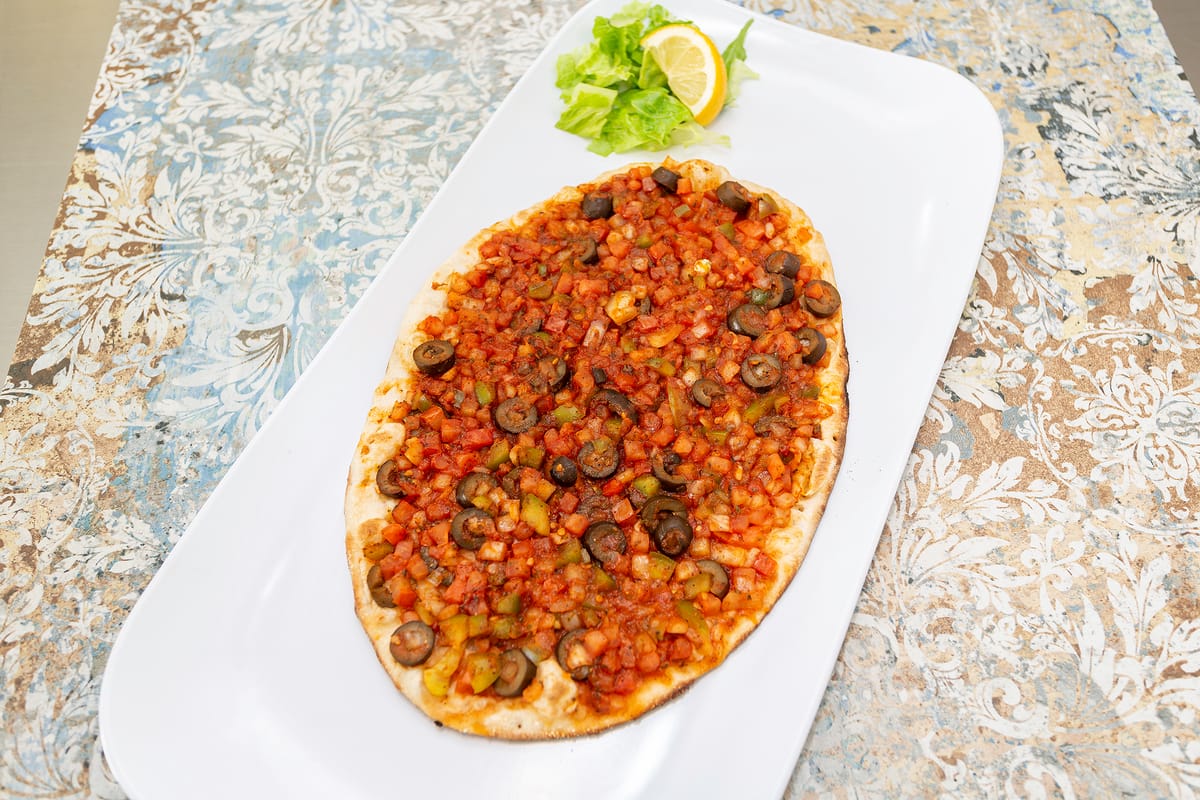
What Is Manakish? The Lebanese Flatbread You Need to Try
Manakish is Lebanon's answer to breakfast bread -- a thin, hand-rolled flatbread topped with zaatar, cheese, or meat and baked in a stone oven until golden. Here is everything you need to know.
4.8 stars on Yelp (92 reviews) -- Open 11:00 AM - 12:00 AM
What Is Manakish?
A straightforward answer to the most common question about Lebanese bread.
Manakish is a Lebanese flatbread made from simple yeast dough, rolled thin by hand, topped with one of several traditional toppings, and baked in a very hot stone oven for three to five minutes. The most common topping is zaatar -- a blend of dried thyme, sesame seeds, sumac, and olive oil -- but cheese, ground meat, spinach, and labneh (strained yogurt) are also standard options. The dough is soft and slightly chewy, similar to pita but rolled flatter and wider. Manakish is the plural form; a single piece is called manousheh or manqousha. The word comes from the Arabic root meaning "to engrave" or "to stamp," referring to the finger indentations bakers press into the dough before adding toppings.
In Lebanon and across the Levant, manakish is the default breakfast. Bakeries open before dawn, and lines form early as workers, students, and families pick up fresh manakish on the way to start their day. A zaatar manousheh with a cup of tea is as fundamental to the Lebanese morning routine as coffee and toast in the United States. But manakish is not limited to breakfast. It works as a light lunch, an afternoon snack, or a side dish at dinner. Its versatility and low cost make it one of the most widely consumed foods in the region.
At Taza Shawarma & Falafel in Falls Church, VA, we bake manakish fresh in our stone oven throughout the day. Zaatar manakish starts at $6.95, cheese manakish at $7.95, and lahm bil ajin (meat flatbread) at $8.95. Each one is baked to order using fresh dough made daily in-house.
Where Does Manakish Come From?
A bread with roots stretching back centuries across the Levant.
Manakish has been a staple of Levantine cooking for at least seven centuries, though the exact origins are difficult to pinpoint because flatbreads with toppings were common across the entire eastern Mediterranean long before written recipes existed. The word "manqousha" appears in historical references to bakeries in Tripoli, Sidon, and Beirut going back several hundred years. The concept is simple enough that it likely evolved independently in multiple communities: stretch dough flat, add whatever topping is available, and bake it in the communal oven.
Zaatar -- the herb blend that defines the most classic manakish -- has been cultivated in the Levant since biblical times. Wild thyme grows abundantly in the mountains of Lebanon and Syria, and local communities have been drying, grinding, and mixing it with sesame seeds and sumac for centuries. The combination of zaatar and olive oil on flatbread became the default breakfast across the region because the ingredients were locally abundant, shelf-stable, and affordable. A family could feed everyone with a few pieces of dough and a bowl of zaatar paste at minimal cost.
As Lebanese communities emigrated in the 20th century -- to West Africa, South America, Europe, and North America -- they brought manakish with them. Today, you can find manakish bakeries in Dearborn (Michigan), Sydney (Australia), Sao Paulo (Brazil), and across the Gulf states. In Northern Virginia, the large Lebanese and Levantine community has made manakish widely available. At Taza in Falls Church, we carry on this tradition using the same stone-oven baking method that Lebanese bakers have used for generations.
The communal baking tradition is central to the story of manakish. In villages across Lebanon, families would prepare their dough at home and bring it to the neighborhood bakery -- the "furn" -- where the baker would top it and slide it into the shared oven. This practice created a daily social ritual: neighbors gathered at the bakery each morning, exchanging news while waiting for their manakish to bake. Though most modern bakeries handle the full process in-house, the communal spirit of manakish endures.
Baked in a Stone Oven
Every manakish at Taza is rolled by hand, topped fresh, and baked in our stone oven until golden and fragrant.
What Are the Most Popular Types of Manakish?
Six classic varieties, each with a distinct topping and flavor profile.
Zaatar Manakish
$6.95
The most traditional variety. A thin flatbread brushed generously with a paste of dried thyme (zaatar), toasted sesame seeds, sumac, and extra-virgin olive oil. The zaatar mixture turns fragrant and slightly crispy in the stone oven. This is the version that most Lebanese families eat for breakfast several times a week. Simple, aromatic, and deeply satisfying. At Taza, our zaatar manakish starts at $6.95.
Cheese Manakish
$7.95
Soft dough topped with a blend of melted cheeses -- typically akkawi, mozzarella, or a regional cheese mix -- and baked until bubbly and golden brown. The cheese pulls in long strings when you tear the bread. Richer than the zaatar version and popular with children. Often eaten folded with fresh vegetables tucked inside. At Taza, cheese manakish is $7.95.
Spinach Manakish
$7.95
Fresh spinach sauteed with caramelized onions, toasted pine nuts, and a squeeze of lemon, spread over the dough and baked. A lighter, vegetable-forward option that delivers a different texture -- the spinach becomes tender and slightly caramelized while the dough stays soft. A favorite among health-conscious diners. Priced at $7.95 at Taza.
Lahm Bil Ajin (Meat Manakish)
$8.95
Thin, crispy flatbread topped with seasoned ground beef or lamb, finely diced onions, fresh parsley, and tomatoes. The meat mixture is spread thin so every bite has both crispy bread and savory topping. Often called 'Lebanese pizza' because of its flat, open-face format. At Taza, lahm bil ajin is $8.95 and baked fresh in our stone oven.
Mixed Manakish
$7.95
A combination topping, usually zaatar on one half and cheese on the other, giving you both flavors in a single flatbread. Some versions mix zaatar into the cheese topping itself. This is a popular choice for people who cannot decide between the two classics. The contrast between the herbal zaatar side and the rich cheese side makes every bite interesting.
Labneh Manakish
$7.95
Thick, strained yogurt (labneh) spread over the dough before baking, then finished with a drizzle of olive oil and sometimes dried mint or cucumber. The labneh becomes warm and creamy in the oven without fully melting like cheese does. This variety is lighter and tangier than cheese manakish and pairs well with fresh vegetables and olives on the side.
How Is Manakish Made?
Three steps from raw dough to finished flatbread. The process is fast, simple, and unchanged for centuries.
The Dough
Manakish dough is made from flour, water, yeast, salt, and a small amount of olive oil or sugar. The dough is mixed, kneaded, and left to rise for one to two hours until it doubles in size. Once risen, the dough is divided into balls, each one enough for a single flatbread. The ball is then rolled flat by hand -- traditionally on a wooden board called a 'sader' -- into a round shape about 10-12 inches across and roughly a quarter-inch thick. The dough should be even in thickness so it bakes uniformly. At Taza, we make our manakish dough fresh every morning.
The Topping
The rolled dough is placed on a flat paddle and the topping is spread across the surface. For zaatar manakish, a thick paste of zaatar, sesame seeds, sumac, and olive oil is spread evenly, leaving a small border of bare dough at the edges. For cheese, a blend of shredded cheeses is distributed in an even layer. For lahm bil ajin, a thin layer of seasoned ground meat with onions and parsley is pressed across the entire surface. The baker uses their fingertips to press shallow indentations into the dough -- this is the 'engraving' that gives manakish its name and helps the topping adhere during baking.
The Baking
The topped flatbread slides into a stone oven heated to very high temperature. Traditional Lebanese bakeries use a 'furn' -- a domed oven with a stone floor that retains intense heat. The manakish bakes for just three to five minutes. The high heat puffs the dough slightly, crisps the bottom, and toasts the topping. Zaatar manakish comes out fragrant and slightly crispy on top. Cheese manakish emerges bubbly and golden. The finished flatbread is removed with a long paddle and served immediately -- folded, rolled, or flat. At Taza, we bake every manakish to order so it arrives at your table hot from the oven.
How Does Manakish Compare to Pizza?
They share a concept -- flatbread with toppings -- but the execution, tradition, and flavor are completely different.
Manakish is sometimes called "Lebanese pizza," and while the label makes it easier for newcomers to understand the concept, the comparison is superficial. Manakish and pizza both involve dough and toppings baked in an oven, but the similarities largely stop there. The dough is different, the toppings come from entirely separate culinary traditions, the baking methods prioritize different results, and the cultural context is not the same. Pizza is a meal. Manakish can be a meal, a snack, or a breakfast staple. Here is a side-by-side breakdown.
| Feature | Manakish | Pizza |
|---|---|---|
| Dough | Thin, soft, slightly chewy -- similar to pita dough, rolled by hand | Thicker (varies by style), typically uses yeast dough with sugar and oil |
| Toppings | Zaatar + olive oil, cheese blend, spinach, ground meat, labneh | Tomato sauce base, mozzarella, meats, vegetables, wide range |
| Cooking Method | Stone oven, very high heat, baked in 3-5 minutes | Conventional or wood-fired oven, 8-15 minutes depending on style |
| Serving Style | Folded or rolled, eaten by hand, often for breakfast | Sliced into triangles, eaten any time of day |
| Origins | Lebanon, Syria, and the broader Levant region -- centuries old | Naples, Italy -- modern pizza dates to the 18th century |
| Calories (typical) | 250-400 per serving depending on topping | 250-350 per slice depending on toppings and crust |
| Meal Occasion | Traditionally breakfast or morning snack, now eaten any time | Lunch, dinner, or late-night meal |
If you enjoy pizza, you will almost certainly enjoy manakish -- but expect a completely different eating experience. The flavors are lighter, the bread is thinner, and the toppings reflect centuries of Lebanese baking tradition rather than Italian culinary convention.
Fresh From the Stone Oven
Every manakish at Taza is baked to order. The dough is made fresh daily, and the toppings are prepared each morning.
How Do You Eat Manakish?
Three traditional ways to serve and eat manakish, from the bakery to the table.
Manakish can be eaten flat like a pizza, folded in half like a taco, or rolled up like a burrito. The method depends on the topping, the setting, and personal preference. There is no single "correct" way -- all three are traditional and widely practiced across Lebanon.
Flat
Eaten open-face, typically at a table with a knife and fork or torn by hand. This is the preferred style for lahm bil ajin (meat manakish) and for any manakish that will be shared. Eating it flat lets you see and taste the topping in its full presentation. It also works well when you want to add extras on top -- a squeeze of lemon, a few olives, or a scoop of labneh.
Folded
The manakish is folded in half while still warm, creating a half-moon shape that is easy to hold and eat by hand. This is the most common way to eat zaatar manakish from a street bakery. Some people stuff fresh vegetables -- tomato, cucumber, mint -- inside the fold before eating. The fold traps heat and keeps the topping from dripping. It is the fastest, most portable option.
Rolled
The manakish is rolled into a tight cylinder, sometimes with additional fillings tucked inside. This is popular with cheese manakish, where the melted cheese stays contained inside the roll. Rolling also works well when you want to add labneh, vegetables, or even meat to a zaatar or cheese base. The rolled format is the most compact and the easiest to eat while walking.
Is Manakish Healthy? A Nutritional Overview
How each variety stacks up in terms of calories, protein, and overall nutritional value.
Manakish is a moderately healthy food, especially in the zaatar and spinach varieties. The dough is simple -- flour, water, yeast, and a small amount of oil -- without the added sugars and preservatives found in many commercial breads. The toppings determine the nutritional profile more than the bread itself.
Zaatar Manakish
Rich in antioxidants from thyme and sumac
Cheese Manakish
Good source of calcium and protein
Spinach Manakish
High in iron, fiber, and vitamins A & K
Lahm Bil Ajin Manakish
Highest protein option with iron from beef
Zaatar manakish stands out as the healthiest option. Thyme (zaatar) contains thymol, a compound with documented antibacterial and anti-inflammatory properties. Sumac is high in antioxidants. Olive oil provides monounsaturated fats linked to heart health. The combination has been a dietary staple in the Levant for centuries, and modern nutritional research supports its place in a balanced diet. For the lightest option at Taza, order zaatar manakish at $6.95.
When Do People Eat Manakish?
From sunrise bakery lines to late-night snacking -- manakish fits every part of the day.
Breakfast Staple
In Lebanon, manakish is the go-to breakfast. Neighborhood bakeries open before 6 AM, and the smell of fresh zaatar and baking bread fills the streets. Families buy several pieces on the way to work or school. A zaatar manousheh with a cup of tea or a glass of ayran (yogurt drink) is the standard Lebanese morning meal. It is fast, affordable, and provides sustained energy for the morning. This breakfast tradition has remained unchanged for generations and shows no sign of fading.
Street Food and Snack
Beyond breakfast, manakish serves as one of the most common street foods in Beirut, Tripoli, and other Lebanese cities. Street vendors and small bakeries sell individual pieces throughout the day. Students buy them between classes. Workers grab them during breaks. The portability of manakish -- folded in half or rolled up -- makes it ideal as a handheld snack. It is also common at picnics, road trips, and casual gatherings where a full meal is not needed but something more than chips is wanted.
Any-Time Meal
In the diaspora and increasingly within Lebanon itself, manakish has broken free of its breakfast-only reputation. Restaurants and bakeries in Northern Virginia, Dearborn, and other areas with large Lebanese communities serve manakish all day long. At Taza in Falls Church, you can order manakish during all operating hours (11:00 AM - 12:00 AM). Cheese manakish makes a satisfying light lunch. Lahm bil ajin works as a dinner appetizer. Zaatar manakish pairs well with hummus and labneh as part of a larger Mediterranean spread.
What Are the Best Manakish Toppings?
A ranked guide to the six most popular manakish toppings, from the all-time classic to the underrated favorites.
Zaatar + Olive Oil
The original and still the most popular. The blend of dried thyme, sesame seeds, sumac, and olive oil is the flavor that defines manakish. Every bakery in Lebanon serves this as the default option.
Cheese Blend (Akkawi + Mozzarella)
Rich, stretchy, and satisfying. The cheese melts into the dough and creates a golden, bubbly surface. The most popular choice among children and a close second overall.
Ground Meat (Lahm Bil Ajin)
Seasoned beef or lamb with onions and parsley. The most substantial topping option and the one that makes manakish a full meal rather than a snack.
Spinach, Onion, and Pine Nuts
The vegetable option that actually delivers on flavor. The caramelized onions and toasted pine nuts add sweetness and crunch that balance the earthy spinach.
Labneh (Strained Yogurt)
Tangy, creamy, and lighter than cheese. Labneh on warm flatbread with a drizzle of olive oil is a classic Levantine breakfast that has been eaten for centuries.
Zaatar + Cheese Combo
The best of both worlds. Half zaatar, half cheese, or a full mix of both. This combination is the default order for anyone who wants variety without ordering two separate flatbreads.
Try Manakish at Taza in Falls Church
Four varieties, all baked fresh in our stone oven. Here is what we offer and what each one costs.
Zaatar Manaeesh
$6.95
Large Mediterranean flat bread with dry thyme, sesame, and olive oil.
Order NowCheese Manaeesh
$7.95
Large Mediterranean flat bread with our signature blend cheese.
Order NowSpinach Manaeesh
$7.95
Large Mediterranean flat bread with fresh spinach, onion, and pine nuts.
Order NowLahm Bi Ajin Manaeesh
$8.95
Large Mediterranean flat bread, ground beef, onion, parsley.
Order NowAll manakish at Taza are baked in our stone oven using fresh dough made daily. Pair any flatbread with a side of hummus ($4.95) or labneh ($4.95) for the full Lebanese breakfast experience.
Manakish: Common Questions Answered
The taste depends entirely on the topping. Zaatar manakish has an earthy, herbal flavor from the dried thyme, a slight tang from sumac, and a rich, nutty quality from the olive oil and sesame seeds. Cheese manakish tastes like warm, melted cheese on soft bread -- mild, rich, and comforting. Lahm bil ajin (meat manakish) has a savory, spiced flavor from the seasoned ground beef with onions and parsley. The bread itself is soft, slightly chewy, and subtly sweet from the yeast dough. At Taza in Falls Church, all manakish varieties are baked in our stone oven, which gives the crust a light char and smoky depth.
No, though the comparison is understandable. Both are flatbreads with toppings baked in an oven. However, manakish uses a thinner, softer dough without tomato sauce. The toppings are different -- zaatar and olive oil, regional cheeses, and ground meat with parsley rather than mozzarella and pepperoni. Manakish is traditionally a breakfast food in Lebanon, while pizza is a lunch or dinner food in Italy. The dough is rolled thinner, baked faster in a hotter stone oven, and served folded or rolled rather than sliced into triangles. They share a concept but come from completely different culinary traditions.
Zaatar manakish is one of the healthier flatbread options available. A single zaatar manakish contains approximately 250-350 calories, with healthy fats from olive oil, antioxidants from thyme and sumac, and complex carbohydrates from the dough. It contains no processed meat, no heavy cheese, and minimal sugar. Cheese manakish is higher in calories (350-450) due to the cheese content but still moderate by fast-food standards. Spinach manakish adds fiber and vitamins from the vegetables. For the lightest option, order zaatar manakish at Taza for $6.95.
Traditionally, manakish is a breakfast food in Lebanon and across the Levant. Bakeries open early in the morning and serve fresh manakish to workers, students, and families on their way to start the day. Zaatar manakish with a cup of tea is the most common breakfast in many Lebanese households. However, manakish is increasingly eaten at any time of day -- as a snack, a light lunch, or a side dish alongside other Mediterranean dishes. At Taza in Falls Church, you can order manakish during all operating hours: 11:00 AM - 12:00 AM.
They are the same food. 'Manakish' and 'manaeesh' are two common English transliterations of the Arabic word. The original Arabic is the plural of 'manqousha,' which means 'engraved' or 'stamped' -- referring to the finger-pressed pattern bakers make in the dough before adding toppings. Some regions and writers prefer 'manakish,' others use 'manaeesh,' and you may also see 'manousheh' (singular) or 'manoushe.' All refer to the same Lebanese flatbread. At Taza, we use 'manaeesh' on our menu but the food is identical regardless of spelling.
Taza Shawarma & Falafel at 5820 Seminary Rd Ste O, Falls Church, VA 22041 serves fresh manakish baked in our stone oven daily. We offer zaatar manakish ($6.95), cheese manakish ($7.95), spinach manakish ($7.95), and lahm bil ajin ($8.95). All are baked to order using fresh dough and quality ingredients. We are open 11:00 AM - 12:00 AM, Open 7 Days a Week. Order online at clover.com or call (703) 340-1014 for pickup.
Get Fresh Manakish at Taza Today
Open 11:00 AM - 12:00 AM, Open 7 Days a Week at 5820 Seminary Rd Ste O, Falls Church, VA 22041.
Address
5820 Seminary Rd Ste O, Falls Church, VA 22041
Hours
11:00 AM - 12:00 AM -- Open 7 Days a Week
Phone
Taste It Fresh From Our Stone Oven
Zaatar, cheese, spinach, or meat -- all baked to order at Taza in Falls Church. Starting at $6.95. Order online or visit us on Seminary Road.