Lebanese food is not just a collection of recipes. It is a philosophy of hospitality, a ritual of gathering, and a living connection to one of the most ancient culinary traditions in the world. To eat Lebanese food — truly eat it, not just consume it — is to participate in a culture built on the idea that the table is sacred, that feeding someone is an act of love, and that no meal is complete until everyone is satisfied. Understanding Lebanese food means understanding how Lebanese people relate to each other, to guests, and to the idea of the table itself.
The Meze Tradition: A Table That Never Ends
If there is one concept that defines Lebanese dining more than any other, it is meze — the tradition of sharing many small dishes rather than individual plates. The word itself comes from the Turkish "meze" (derived from the Persian "mazze"), and the concept predates Ottoman influence, traceable to the custom in ancient Persia and the Levant of serving many small dishes with wine. In Lebanon, meze is not simply an appetizer course. It is, for many meals, the entire structure of eating.
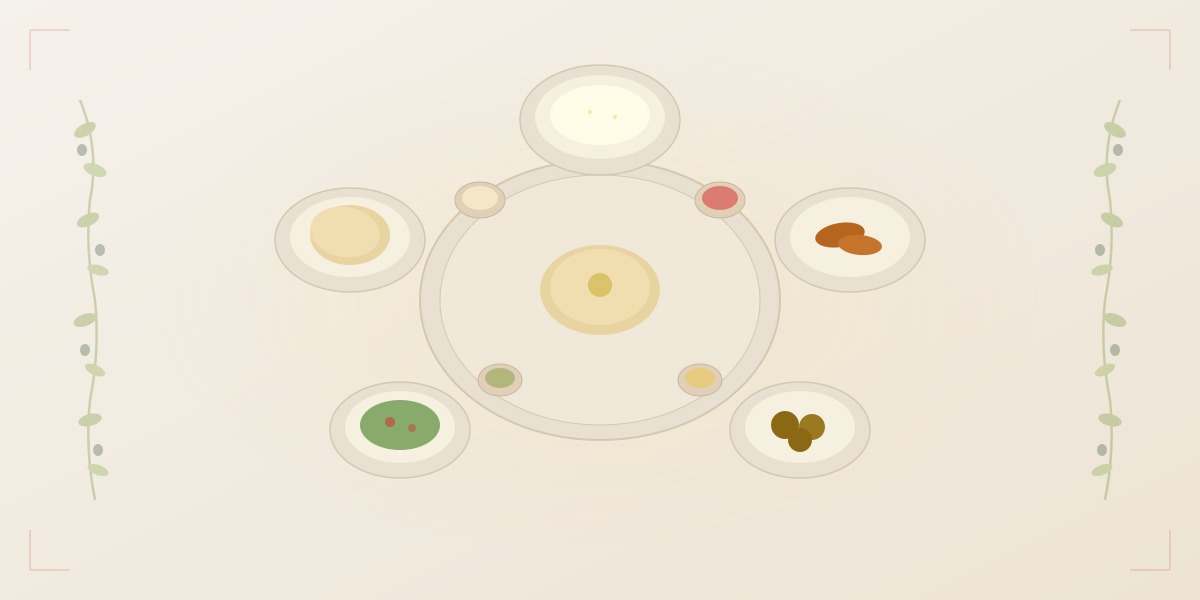
A proper Lebanese meze table is an overwhelming abundance. Hummus arrives first — or simultaneously with dozens of other dishes — followed by baba ghanoush (smoky roasted eggplant), tabbouleh (the herb-forward bulgur and parsley salad), fattoush (the bread salad with sumac dressing), kibbeh (the spiced lamb and bulgur croquette), warak enab (stuffed grape leaves), labneh with olive oil and zaatar, fresh vegetables for dipping, warm bread for scooping, olives, radishes, and whatever else the host has prepared or the restaurant has available.
In Lebanese culture, the worst thing you can say about a host is that their table was bare. The imperative is abundance — more than can possibly be eaten — because abundance signals care, and care is the whole point.
— Anissa Helou, Lebanese food writer
The meze tradition reflects a fundamental Lebanese value: generosity as a form of dignity. A guest who leaves hungry is a failure of the host, and a host who serves only enough is, by Lebanese standards, not really hosting at all. This is not mere cultural performance — it is a deeply held value, expressed in food, that care for others is the highest form of self-expression.
Hummus: The Dish That Holds a World Together
No discussion of Lebanese food traditions is complete without the hummus conversation, and it must be had honestly. Hummus — the creamy blend of cooked chickpeas, tahini, lemon juice, garlic, and olive oil — is simultaneously one of the most beloved and most misunderstood foods on the international stage. What passes for hummus in most American grocery stores is to Lebanese hummus what a gas station burrito is to a handmade tortilla from Oaxaca: nominally the same thing, categorically different experiences.
Proper Lebanese hummus begins with dried chickpeas, soaked overnight and cooked until they are so soft they dissolve between your fingers. The warm chickpeas are blended with a generous amount of tahini — not a spoonful, but enough that the tahini flavor is front and center, not an afterthought — along with freshly squeezed lemon juice, raw garlic, and salt. The key is the temperature: blending warm chickpeas produces a creamier, silkier result than cold ones, and the final texture should be smooth enough to pour slowly, not stiff enough to hold ridges.
Pro Tip
The definitive test of great hummus: it should be pourable when warm, not scoopable. If you can see tool marks in your hummus that stay in place, it needs more tahini, more lemon, or more blending. Great hummus flows slowly into its final shape like a thick cream.
Tabbouleh: The Herb Salad That Changed the World
Outside the Levant, tabbouleh is often described as a bulgur salad with herbs. This description is precisely backward. Tabbouleh is an herb salad with a small amount of bulgur. The hero of tabbouleh is flat-leaf parsley — enormous quantities of it, finely chopped — combined with fresh mint, ripe tomatoes, green onions, lemon juice, olive oil, and just enough fine-ground bulgur to give the salad some body. A tabbouleh in which you can see more grain than herbs is not a properly made tabbouleh.
Lebanese tabbouleh is one of the great salads of world cuisine because it is perfectly balanced. The acidity of the lemon and tomatoes cuts the bitterness of the raw parsley. The olive oil rounds everything out with richness. The bulgur provides a subtle chewy contrast. The mint adds coolness that makes each bite fresh. And the whole thing is assembled at the last moment — never in advance, because tabbouleh wilts and the parsley softens unattractively if it sits too long dressed.
Did You Know?
A good rule of thumb for authentic tabbouleh: if you can see more grain than herbs, send it back. The parsley should be so abundant that the bulgur is almost hidden. In Lebanon, the ratio is roughly 4:1 parsley to grain by volume.
The Bread Imperative
Lebanese bread — known variously as khobz, pita, or Arabic bread — is not a side item. It is a utensil. In Lebanese culture, eating without bread is nearly inconceivable; the bread is how you scoop the hummus, how you wrap the falafel, how you wipe the plate of the last traces of tahini, how you pick up a bite of tabbouleh. The bread is not something you eat with your meal. The bread is the eating implement without which the meal cannot properly function.
Traditional Lebanese bread is baked at extremely high heat for a very short time — thirty seconds to a minute in a wood-fired oven, which causes it to puff dramatically as steam builds inside, then deflate into two thin layers separated by a pocket of air. This pocket is the functional feature: it can be filled, opened, torn, or used as a scoop. The bread should be soft, slightly chewy, and smell of wheat and yeast. Day-old bread is acceptable for fattoush (where it is toasted and broken), but for dipping and scooping, it should be warm from the oven.
Family and Community at the Table
Lebanese food traditions are inseparable from Lebanese family culture, and Lebanese family culture is intensely communal. The kitchen is the heart of a Lebanese home in a way that is literal rather than aspirational — it is the room where the day begins (with a zaatar breakfast), where news is shared (over midday coffee), and where the evening is organized (around a dinner that is never rushed). Food is the language through which care is expressed, conflict is softened, and belonging is established.
For diaspora communities — and Falls Church is home to a large and established Lebanese-American community — maintaining these food traditions is a form of cultural preservation. The grandmother who makes kibbeh by hand every Sunday is not just making lunch; she is transmitting memory, keeping alive a set of techniques and flavors that connect her grandchildren to a country they may never have visited. The restaurant that serves real Lebanese food is not just feeding people; it is serving as a cultural anchor.
We don't just miss Lebanon when we leave. We miss the smell of the kitchen in the morning. We miss the sound of the mortar and pestle. We miss the particular chaos of a table where everyone is talking and reaching and nobody has finished eating. You can't export that. But you can recreate it, if you try hard enough.
— A Lebanese-American resident of Falls Church
Lebanese Coffee and the Ritual of Hospitality
No account of Lebanese food traditions can omit Lebanese coffee — a lightly roasted coffee brewed in a small copper pot (rakweh) with cardamom, poured into tiny demitasse cups and served throughout the day as a gesture of welcome. The offering of coffee to a guest is not optional in Lebanese culture; it is an obligation. To arrive at a Lebanese home and not be offered coffee would be such a profound lapse of hospitality as to be almost unimaginable.
The coffee itself is distinctive. Lebanese coffee is lighter in roast than espresso — more golden-brown than dark — and the addition of cardamom gives it a floral, slightly spicy warmth that distinguishes it from both Turkish coffee and Italian espresso. It is brewed very concentrated and served in small amounts, meant to be sipped slowly and extended over conversation. The cup is a pretext for sitting, for talking, for being in each other's company. The coffee is secondary to the conversation it enables.
Celebrating Lebanese Traditions in Falls Church
At Taza Shawarma & Falafel on Seminary Road in Falls Church, we are aware every day that we exist within a community that knows exactly what Lebanese food should taste like. Our customers include people who grew up eating these dishes in Beirut, Tripoli, and Sidon; people whose parents and grandparents brought these traditions to Virginia decades ago; and people who are encountering Lebanese cuisine for the first time and deserve to experience it at its best.
We approach every dish with that context in mind. Our hummus is made from soaked and cooked dried chickpeas, blended with tahini that we consider a primary ingredient rather than a finishing touch. Our tabbouleh is herb-forward, prepared fresh, dressed only when it is about to be served. Our bread is kept warm. Our falafel is fried to order. These are not marketing claims — they are the practices that distinguish food made with care from food made for convenience.
- Fresh-made hummus from dried chickpeas — never from a commercial base
- Tabbouleh prepared to order, herb-heavy and lemon-bright
- Falafel fried fresh, never pre-cooked and reheated
- Warm bread served with every meal — not as an afterthought
- Garlic sauce (toum) made in-house — the real emulsion, not garlic mayo
- Shawarma marinated overnight in a traditional Levantine spice blend
- Manaeesh made with generous amounts of real zaatar and good olive oil
Lebanese food is a living tradition. It is not preserved behind glass in a museum — it evolves, adapts, and finds new homes in new places. Falls Church is one of those homes, and we are glad to be part of the story. Every time a family gathers around our food and the table fills with the sound of Arabic and laughter and the passing of plates, we feel the continuity of something that stretches back centuries: the Lebanese conviction that to feed someone well is to love them.